Ordering custom patches for the first time can be a daunting task. Several clients tend to hurry through the design stage, which leads to unnecessary errors that end up wasting their valuable time and money. When equipping your corporate group or designing merchandise with Infinite Digitizing, understanding the technical and physical requirements is necessary to achieve perfection with your custom embroidered patches.
Why Most First-Time Patch Orders Go Wrong
First-time ordering of custom embroidery patches can be daunting. Many customers tend to hurry their orders, which results in avoidable mistakes that take away time and money.
- Poor File Quality: Sending the patch manufacturer low-resolution files, such as JPEG, instead of vector files, makes for poorly made stitches when you make custom patches.
- Backing Mismatches: Using inappropriate backings for your material, such as sending an iron-on patch when your material is heat-sensitive.
- Type Confusion: Confusing embroidery patch types with PVC because they have to be made using different methods.
- MOQ Oversights: Not checking minimum order quantities and finding yourself with unexpected expenses.
- Lack of Proofing: Although you will eventually get your products, this will not happen in the way that you expected, should there be no proofing of the product.
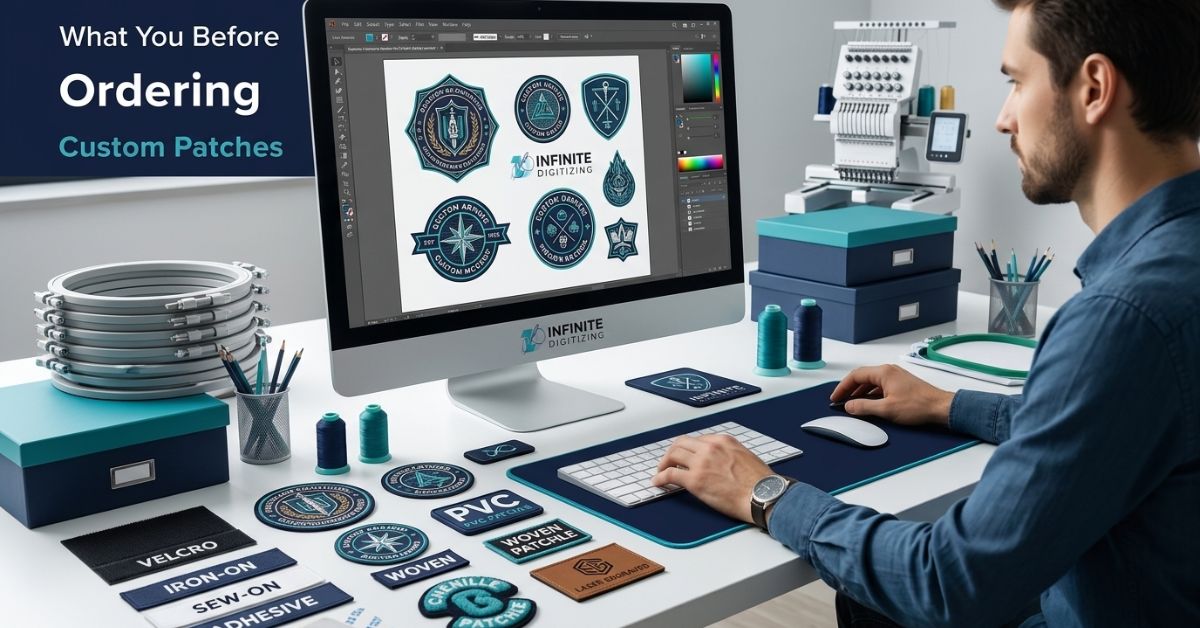
Patch Types at a Glance: Which One Do You Need?
Different material requirements for different projects. Understanding the distinct properties of each type helps ensure your custom patch embroidery looks and performs exactly as expected.
| Type | Material | Best For | Durability |
|---|---|---|---|
| Embroidered | Twill Fabric | Uniforms, Jackets, Hats | High |
| PVC Patches | Soft Rubber/PVC | Tactical, Outdoor Gear | Very High |
| Woven | Fine Thread | Detailed, Small-Text Designs | High |
| Chenille | Yarn Loops | Varsity, Letterman Styles | Medium |
| Leather | Genuine/Faux Leather | Premium Apparel Branding | High |
Getting Your Artwork Right (File Formats That Work)
Your design will dictate the overall quality of your embroidery patch. If you want great embroidery, then there are certain formats that you need for this purpose.
- Vector Files: You will be required to provide a custom patch embroidery in AI, CDR, PDF, or EPS file types to make sure that you receive excellent quality patches.
- Avoid Raster Images: Poor-quality raster images produce blur effects. It is advisable not to use raster files at all.
- Conversion Process: We convert your flat design to DST, PES, or EXP professional files to make custom patches.
- Detail Preservation: The vector files allow us to ensure that all details, including text and logos, look nice and legible for every embroidery patch.
Choosing the Right Backing: Velcro, Iron-On & More
The backing will determine the type of attachment of your custom embroidery patches to your equipment. Choose the option that fits your use of the patch most appropriately.
- Velcro Backing: Best suited for use on tactical clothing since it is easy to take off and put back on.
- Iron-On: Good for attaching the patch to clothes made of cotton and denim.
- Sew-On: Most reliable choice; suits work clothing because of frequent industrial washing.
- Adhesive Backing: Great option for temporary patches for events or promotions and custom patch embroidery projects.
Edge Finish Explained: Why Merrowed Edge Matters
The edge finish defines the silhouette of your design. Choosing the right border ensures the custom embroidery patches look polished rather than unfinished.
- Merrowed Edge: A thick, overlocked border that creates a raised frame; the standard choice for simple shapes.
- Hot-Cut Edge: Uses a laser to cut the border, allowing for complex, irregular shapes.
- Die-Cut: Precise cutting for detailed silhouettes, common in PVC and specialized custom embroidery patch projects.
Fabric & Material: Twill vs PVC Patches
Material Selection will affect the aesthetics as well as the usability of your product.
- Twill Fabric: It is a conventional, adaptable material for most embroidery patch projects.
- PVC Patches: A contemporary, water-resistant rubber patch, suitable for outdoor use where fabric may wear out or become wet.
Minimum Quantities, Pricing & Turnaround
We believe in flexibility for all our clients. Pricing depends on your specific design needs.
- Custom Scaling: We work with various quantity levels, unlike many overseas suppliers who struggle to make custom patches.
- Pricing Factors: Costs are calculated based on size, total stitch count, backing, and edge finish.
- Turnaround: We offer a 24-hour digitizing turnaround to keep your project on schedule.
- Digital Proofs: Always review the digital mock-up we send before we authorize your production run.
How to Place Your Order with Infinite Digitizing
Ordering customized embroidery patches is simple. To make sure an effortless process, please follow the steps below.
- Prepare: Make your design using CorelDRAW or Adobe Illustrator software to create custom patches.
- Select: Select the back, size, and patch type.
- Submit: Send your artwork for our professional custom embroidery patches digitizing review.
- Approve: Check your 24-hour digital proof for accuracy.
- Produce: Confirm the proof, and we will begin crafting your custom patch embroidery order.
Conclusion
Proper order placement of custom-made patches depends on proper preparations and communications. You need to have chosen the right backing, provided good vector images, and performed an intense examination of all proofs in order for your purchase to turn out to be a successful one. Infinite Digitizing is here to help turn your dreams into reality by creating customized patches for you.
Infinite Digitizing delivers precision-crafted custom patches, combining expert vector optimization with high-quality materials for your brand.
Get Your Free Digitizing Quote Today!
FAQs
1. What should I check before ordering custom patches online?
A: Verify your artwork is vector-based, choose appropriate backing, and confirm production details before ordering.
2. What are the most common types of custom patches?
A: Common options include embroidered, PVC, woven, chenille, and leather patches for various applications.
3. What is Velcro backing in patches?
A: Velcro backing allows patches to be easily attached, removed, and repositioned on tactical or apparel gear.
4. What is a merrowed edge in embroidery patches?
A: It is a thick, overlocked, raised border providing a polished finish for standard patch shapes.
5. Can I upload my own design for custom patches?
A: Yes, submit your high-quality vector artwork for professional review and digitizing before production begins.