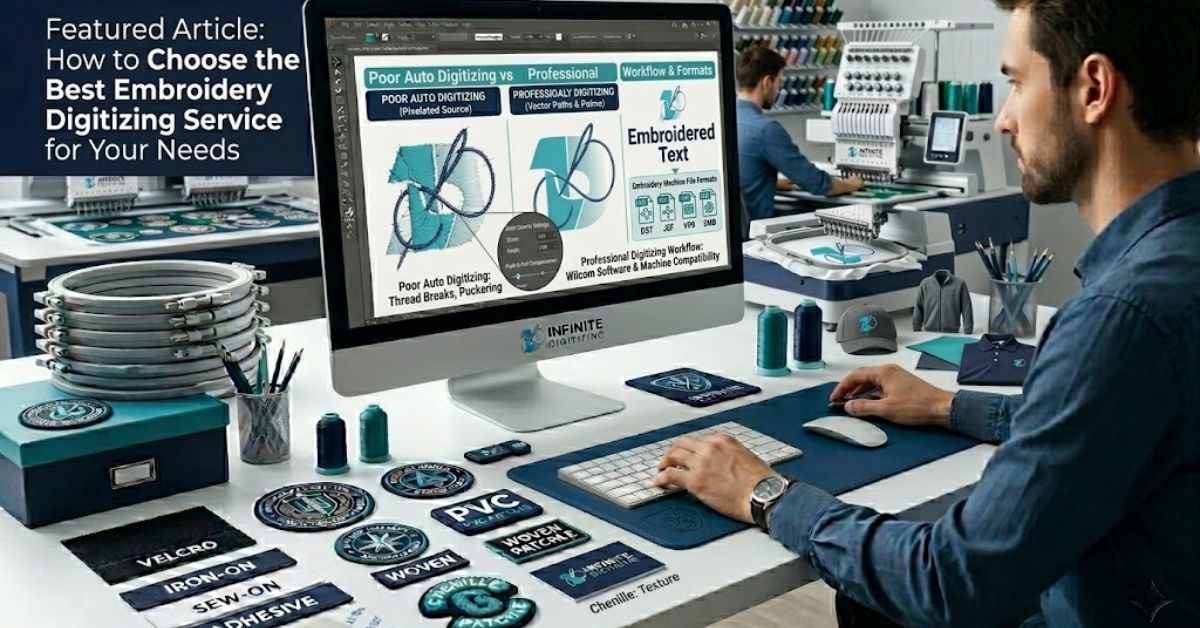
Picking the right embroidery digitizing services keeps your production quality high and saves your money. At Infinite Digitizing, we believe that expert digitizing is the foundation of professional embroidery results. Focus on tech skills, expert tweaks, and top software, not just quick turnarounds or low prices. Find a partner who gets fabric physics and machine needs to step up your embroidery game from basic to pro-level excellence.
Why Choosing the Right Embroidery Digitizing Service Matters
Choosing the right partner for your best embroidery digitizing services needs is not just about getting a file; it’s also about making sure your production quality stays high. When you use professional digitizing services for embroidery, you are putting money into the base of your final product.
- Avoids Machine Downtime: Professional files help stop thread breaks and needle jams.
- Ensures Visual Quality: Proper digitizing stops fabric from getting wrinkled and designs from being out of place.
- Industry Standard Tools: Top digitizing embroidery services use Wilcom Embroidery Studio for accurate work.
- Cost Efficiency: Quality files result in fewer rejections and wasted materials.
Key Factors to Evaluate Before You Order
When picking the best embroidery digitizing service, go for reliability instead of low prices. Affordable choices frequently use automated software, which can’t match the human touch needed for tricky fabrics and designs.
| Factor | What to Check |
|---|---|
| File Formats | Ensure they provide DST, PES, JEF, VP3, and EMB file formats. |
| Stitch Density | The service must adjust stitch density based on your fabric type. |
| Push & Pull Compensation | Necessary to keep designs from warping on stretch fabrics. |
| Underlay Stitch | Essential for stabilizing the fabric and preventing stitches from sinking. |
| Software Used | Wilcom Embroidery Studio is the industry gold standard. |
| Turnaround Time | Expect 24–48 hours for standard quality work. |
| Revision Policy | A top-tier service offers free revisions until the design is approved. |
Factor 1: File Format Output: DST, PES & Beyond
Professional digitizing embroidery services understand that different machines “speak” different languages. A high-quality embroidery digitizing service will always offer you the format specific to your machine without extra fees.
- DST File Format: The universal Tajima standard. This is the gold standard for all commercial multi-head machines.
- PES File Format: The native language of Brother embroidery machines, widely used by home and semi-pro shops.
- Customization: We support DST, PES, JEF, VP3, and EMB formats to make sure your machine runs designs smoothly without issues via our digitizing services for embroidery.
Factor 2: Stitch Density & Fabric Compatibility
Stitch density means how many stitches fit into an inch of space. If a design is too dense, the fabric could get damaged. And if it’s too sparse, the design looks thin and cheap. A professional using quality digitizing services for embroidery knows to adjust their settings; for instance, heavy denim needs very different stitching than a lightweight polo.
- Fabric-Specific Settings: Digitizers must request your fabric type before beginning the design.
- Avoiding Damage: Proper density prevents the needle from perforating the fabric.
- Visual Balance: Correct settings ensure your logo looks solid and professional, not flat or clumpy.
Factor 3: Push and Pull Compensation Accuracy
The needle and thread tension pull on the fabric, causing it to warp during the embroidery process. Push and pull compensation is a critical technical adjustment that “pre-distorts” the digital design so that, once the fabric stretches, the final image looks perfectly square. If the best embroidery digitizing service doesn’t apply this per element, your letters will look jagged, and your shapes will be misaligned.
- Prevents Warping: Maintaining precise letter and logo alignment after hooping is crucial.
- Essential for Stretchy Fabrics: For jersey textiles, caps, and polo shirts.
- Manual Adjustment: Instead of using blanket settings, expert sewists manually adjust each design element in professional digitizing embroidery services.
Factor 4: Underlay Stitch Quality
The underlay thread gives your embroidery a key structure, which acts as the frame. It’s the first layer that keeps everything secure, keeping the design on the fabric and giving a solid base for those top stitches. If you don’t use the right backing, the top thread will disappear into soft fabrics, making the design look unclear. By relying on a professional embroidery digitizing service, you ensure the right underlay is used.
- Stabilization: Anchors the design securely to the fabric.
- Design Definition: Stops top stitches from going down too much, keeping the embroidery looking clear and neat.
- Variety: Experts use different styles like center run, edge run, or zigzag based on what the design needs. Experienced digitizing services for embroidery apply the correct underlay type.
Factor 5: Software & Expertise (Wilcom Embroidery Studio)
Not all software is created equal. Wilcom Embroidery Studio is the industry leader because it allows for precise, manual control over every single stitch. Many cheap online digitizing embroidery services use “auto-digitizing” tools that ignore the physics of fabric. When you choose a service that uses professional software, you are paying for human expertise and an embroidery digitizing service with proven results.
- Manual Precision: Every file is hand-crafted by certified operators.
- True Simulation: Allows for real-time visualization of how the design will look on the machine.
- Avoiding Automation: “Auto-converters” skip the logic of compensation and underlay, leading to poor results. The best embroidery digitizing service prioritizes manual quality checks.
Quick Checklist: Best Embroidery Digitizing Service vs. Low-Cost Alternatives
| Criteria | Infinite Digitizing | Cheap/Auto Services |
|---|---|---|
| DST + PES Output | All Major Formats | Limited |
| Stitch Density | Per Fabric Type | One-Size-Fits-All |
| Push & Pull Compensation | Applied Manually | Skipped |
| Underlay Logic | Manual Per Element | None/Auto |
| Software | Wilcom Embroidery Studio | Auto-Converters |
| Turnaround | 24 Hours | Varies |
| Revisions | Free | Paid Extras |
Conclusion
Investing in a premium embroidery digitizing service from Infinite Digitizing accelerates your path to operational success. It lets you skip the traps of one-size-fits-all automation, keeping your designs strong and stunning. Pick a precise, manual service partner, and your embroidery output becomes more reliable and profitable.
Transform your embroidery with Infinite Digitizing’s expert, manual services tailored perfectly for your specific fabric needs.
Get Precision Digitizing For Every Design!
FAQs
1. What is embroidery digitizing?
It is the process of converting artwork into digital stitch files for embroidery machines.
2. What file formats are used in digitizing?
Common formats include DST, PES, JEF, VP3, and native EMB files for Wilcom software.
3. What is stitch density in embroidery?
It is the frequency of stitches per inch, adjusted to suit different fabric thicknesses.
4. What software is used for digitizing?
Wilcom Embroidery Studio is the industry-leading software for professional, manual, and precise stitch creation.
5. What makes a good digitizing service?
Human expertise, manual push/pull compensation, proper underlay application, and compatibility with specific machine requirements.