
Finding the right finish for your custom patch is a big decision. You may want a traditional raised frame or a modern, sharp look, and the right choice depends on your shape and how the patch will be used. This article breaks down the two border types so you can order with confidence.
What Is a Merrowed Border?
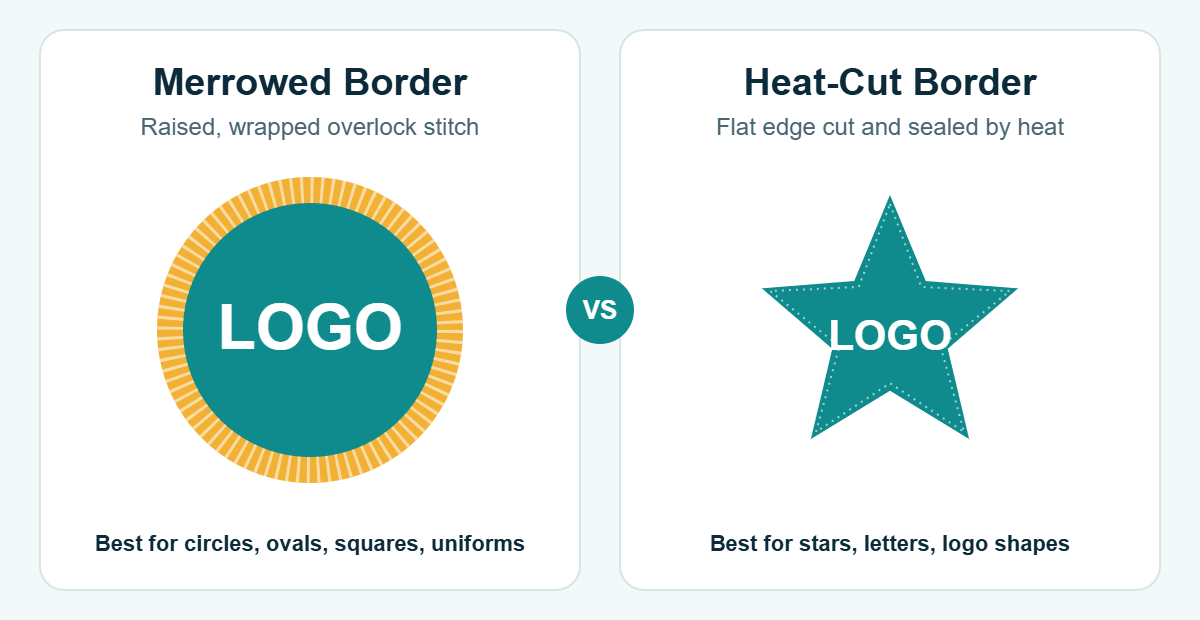
A merrowed border, also called an overlock border, is stitched with a merrow machine after the design is embroidered. The machine wraps thread tightly around the cut edge, which gives the patch a thick, rounded rim.
It is the classic patch edge you see on scout badges, club patches, and work uniforms. What a merrowed border offers:
- A strong, finished rim. The dense wrapped stitches stop the edge from fraying.
- A traditional look. It reads as a “real” patch from across the room.
- A good fit for heavy fabrics. Twill, felt, and leather work very well with a merrowed edge.
What to watch:
- Shape limits. The merrow machine needs a smooth, continuous edge to follow. Complex shapes may not get the clean, rounded rim the technique is known for.
- Space on small patches. The border is around 5 mm wide, and that width is added around your design, so it takes real space on a small custom patch.
What Is a Heat-Cut Border?
A heat-cut border, also called a hot-cut border, is made by cutting the patch out with a heated tool or a laser. The heat melts the fabric fibers slightly as it cuts, which seals the edge and stops it from fraying. The hot-cut process cuts and seals in one step.
The result is a flat, sharp edge that hugs the outline of your design. There is no thick rim, so the artwork reaches almost to the edge.
What a heat-cut border offers:
- Any outline. It follows letters, points, logos, and character shapes closely.
- A modern, clean look with a crisp, flat edge.
- More room for the design, since a 5 mm rim would eat into small patches.
What to watch: it is fray-resistant, but it does not have the wrapped stitches of a merrowed rim.
| Feature | Merrowed Border | Heat-Cut Border |
|---|---|---|
| Edge finish | Thick, raised overlock rim | Flat, sealed, thin edge |
| Shapes | Smooth, simple outlines | Any outline, including points |
| Durability | Highest fray resistance | Sealed, but thinner |
| Design space | About 5 mm rim added around art | Art reaches almost to the edge |
| Look | Classic, traditional | Modern, clean |
Which Patch Shapes Need a Heat-Cut Edge?
The simplest rule is this: if a pencil can’t trace the outline in one smooth loop without sharp turns, you need a heat-cut edge. Heat-cut is the only option for shapes with narrow points or inward corners. Merrowed borders are best for standard shapes such as circles, squares, and rectangles.
| Patch Shape | Merrowed | Heat-Cut |
|---|---|---|
| Circle or oval | Yes | Yes |
| Square or rectangle | Yes | Yes |
| Shield or simple badge | Usually | Yes |
| Star or pointed shape | No | Yes |
| Logo-shaped or die-cut outline | No | Yes |
| Letters, mascots or characters | No | Yes |
| Shapes with inward (concave) corners | No | Yes |
If you are not sure, send your artwork with your custom patch request and ask which edge the shape can take. A good embroidery patch maker will flag it before production, not after.
Durability: Which Edge Lasts Longer?
A merrowed border is generally the more durable edge. The thick wrapped stitch protects the cut fabric from rubbing and washing.
Merrowed borders are highly durable and very fray-resistant, while heat-cut borders are thinner and may be less durable. That doesn’t make heat-cut weak. The heat seals the fibers, so a well-made heat-cut patch holds up well on hats, bags, and jackets. The difference shows up on patches that take daily abrasion, such as work uniforms washed every week. If you are patching workwear, our guide to digitizing logos for workwear and uniforms covers how to build designs that survive heavy washing.
| Use | Better Edge | Why |
|---|---|---|
| Work uniforms washed often | Merrowed | Wrapped stitches protect the edge |
| Heavy outdoor or workwear | Merrowed | Thick rim resists rubbing |
| Caps and hats | Heat-cut | Clean edge suits curved, detailed logos |
| Fashion and merch | Heat-cut | Custom shapes and a modern look |
| Club and scout badges | Merrowed | Classic look, simple shapes |
Does the Border Change the Price?
Yes, it can. The edge is a separate production step, and the steps differ in labor. Things that affect price more than the edge:
- Size. Larger patches need more stitches.
- Embroidery coverage. 100% stitched patches cost more than patches with visible twill.
- Quantity. Unit price usually drops as order quantity rises.
- Backing. Some backings add a step. See our guide to ordering custom patches online for what to check in a quote.
Can You Combine Both Edges?
A patch gets one finish around its outside: either the merrow machine wraps it, or a hot knife or laser cuts it. But you can get the look of a stitched border on a custom shape. The patch is embroidered with a satin-stitch border inside the outline, then heat-cut just outside it. If you like this idea, see how satin borders are built in our guide to digitizing appliqué designs.
This combination gives you:
- A stitched frame around the design
- A sealed edge that follows any shape
- More durability than a plain heat-cut edge
It’s a smart middle option for logo-shaped custom embroidery patch orders that still need to look finished.
How to Choose the Right Border
Use this checklist before you place an order:
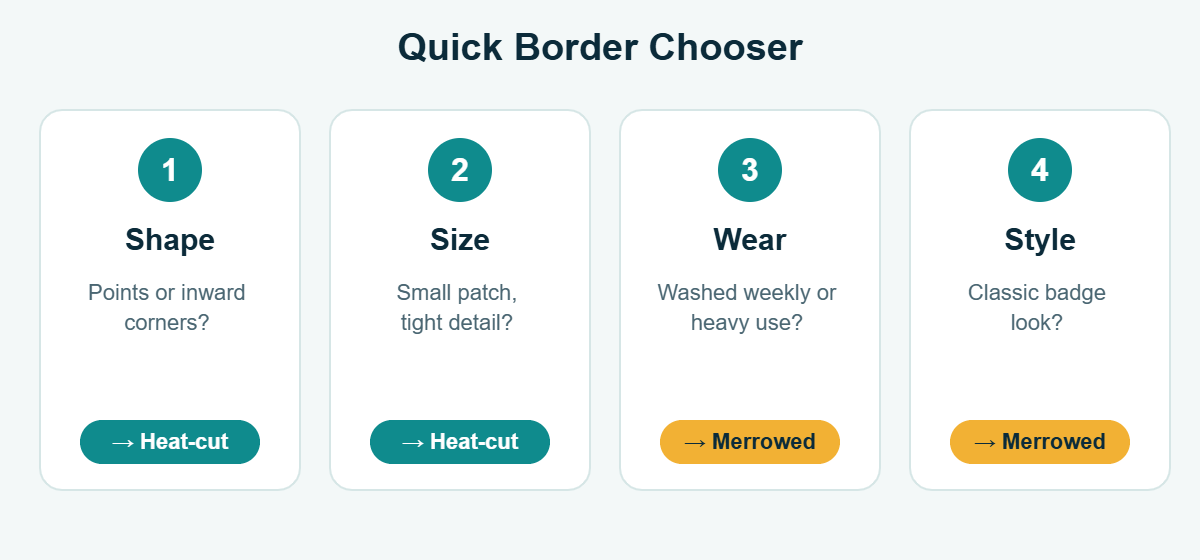
- Check the shape. Points or inward corners mean heat-cut.
- Check the size. On small patches, a 5 mm merrowed rim takes space from the design.
- Think about wear. Weekly washing or heavy abrasion favors merrowed.
- Match the style. Classic and traditional favors merrowed. Modern and custom favors heat-cut.
- Compare like for like. Ask every supplier to quote the same edge.
Also think about the patch type. Woven patches carry finer detail than embroidered ones and are often heat-cut or laser-cut. Compare them in our guide to woven vs embroidered patches, or look at our custom woven patches service. And if your logo isn’t ready for stitching yet, read our custom patch embroidery logo guide.
Order Custom Embroidered Patches with the Right Edge
At Infinite Digitizing, we digitize and produce custom patches with merrowed and heat-cut borders. We check your artwork first and tell you which edge your shape can take, so you don’t find out after the patches arrive.
Not sure which edge fits your design?
Send us your artwork for a quote, and we’ll recommend the border before we start.
FAQs
1. What is the difference between a merrowed border and a heat-cut border?
A merrowed border is a thick, raised overlock stitch wrapped around the patch edge. A heat-cut border is cut and sealed with a hot knife or laser, leaving a flat, thin edge. Merrowed suits simple shapes. Heat-cut follows any outline.
2. Which patch shapes need a heat-cut edge?
Any shape with narrow points or inward corners needs a heat-cut edge. That includes stars, letters, mascots, and logo-shaped outlines. Circles, ovals, squares, and rectangles can take either edge.
3. Is a merrowed border more durable than a heat-cut border?
Generally, yes. The dense wrapped stitches give the most fray-resistant edge, which matters on uniforms that are washed often. Heat-cut edges are sealed and still durable, but they are thinner.
4. Does the border type change the price of a custom patch?
It can. Merrowed borders take more labor and often cost more. Heat-cut borders use a simpler process and are often cheaper. Size, stitch count, and quantity usually affect price more than the edge.
5. Can a patch have a merrowed border and a heat-cut edge together?
Not on the same edge. But a patch can have an embroidered satin border stitched inside the outline and then be heat-cut around it. You get a stitched frame on a custom shape, with a sealed edge.